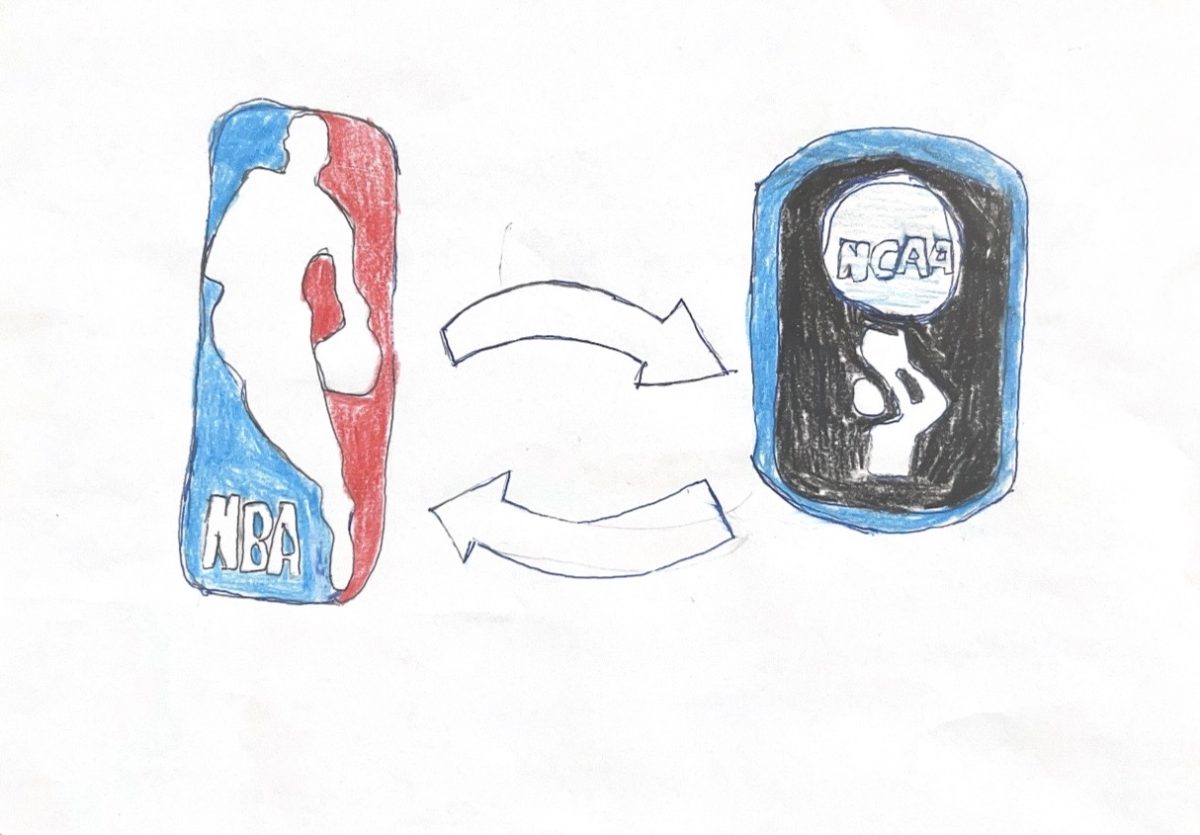
In the 2025-2026 National Basketball Association (NBA) season, there’s been a growing number of players returning to the National Collegiate Athletic Association (NCAA).
As of Feb. 2026, there’s been a total of three players who were given permission to play college basketball again: James Nnaji, ex-EuroLeague and 2023 NBA Draft Pick, London Johnson, with three seasons in the Gatorade league (G league) and Charles Bediako, with three seasons in the G league.
“Originally, I thought it was kind of stupid. If you’re at a pro level, there’s no reason to go back a step,” Andrew Airey, junior JHS basketball player, said.
Johnson has been given two years of college eligibility and won’t play college basketball this season, whereas Nnaji and Bediako have combined for 12 games in their respective returns. Nnaji joined Baylor University and Bediako joined University of Alabama.
Nnaji has played with limited minutes, averaging 1.7 points and 2.8 rebounds per game and shooting 72.7%.
Nnaji had never played in an official NBA game, but became the first former NBA draft pick to be cleared by the NCAA.
Bediako’s college career was short lived, as a Tuscaloosa County Circuit judge ruled him ineligible to play college basketball again. During the five games he played in, Bediako averaged 10.0 points and 4.6 rebounds.
“[Bediako] failed to demonstrate that he is entitled to the injunctive relief that he seeks,” County Circuit Court Judge Daniel Pruet said, according to court documents.
On Feb. 9, 2026, Judge Pruet ended his second college stint, Bediako asked the Alabama Supreme Court to give him “interim injunctive relief,” which is a temporary pause in his ruling, so he can play the rest of the season for Alabama.
NCAA Basketball coaches of well-known teams have had a lot to say about the topic, with big names like John Calipari of the University of Arkansas, Tom Izzo of Michigan State University and Dan Hurley of the University of Connecticut commenting.
“Now we’re taking guys that were drafted in the NBA,” Izzo said in a post-game interview. “If that’s what we’re going to do, shame on the NCAA.”
In a six-minute response, Calipari said, “Real simple. The rules are the rules, so if you put your name in the [NBA draft]… you can’t play college basketball.”
So why are Nnaji, Bediako and others allowed to play again?
The loophole is contracts. Although Nnaji got drafted, he never signed a full deal. The NCAA Division I Manual states if players sign a contract, their college eligibility ends.
“The NCAA has not and will not grant eligibility to any prospective or returning student-athletes who have signed an NBA contract [including a two-way contract],” NCAA President Charlie Baker said.
Since Bediako had a regular, not two-way, contract and Nnaji had an overseas contract, they were granted eligibility.
The primary driver for these “do-overs” is that college basketball, with Name, Image and Likeness (NIL), now offers more money than many international leagues and G-League contracts.
“Emotionally, I feel like it must be hard on them because they have to deal with a bunch of hate,” Airey said. “I guarantee you a lot of people are not happy about these guys going back to college.”
NIL seems to be the biggest reason for many things in college sports, from college football extending its playoffs to make more revenue to players rejoining college ball.
You can learn more about what NIL is and its impact on the sport here.
The appeal is there for the pro players. AJ Dybantsa, Brigham Young University (BYU) star, is making $4.2 million a season off of NIL. Other notable, future NBA players like JT Toppin, Cameron Boozer and Morez Johnson make two million or more a year.
The average G league salary is $45,000 a season.
“Going back to college to make money and play easier isn’t beneficial for anyone,” Airey said.