

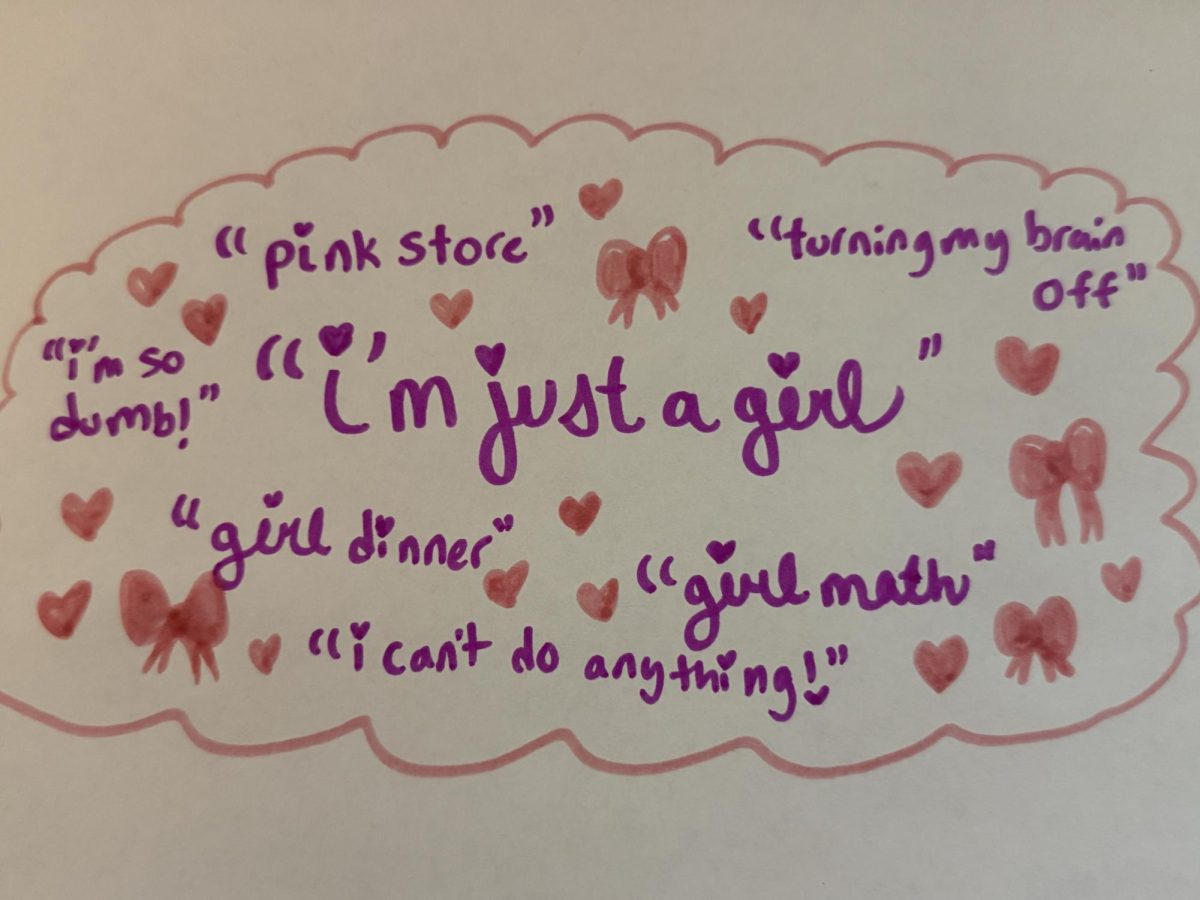
If you’ve been on social media in the past year, you’ve probably seen women post trends including buzzwords such as “girl math”, “girl dinner” or, “I’m just a girl”. You may have seen women with male partners post content with captions such as “doing —- while my boyfriend’s at his big boy job” or “turning my brain off around my boyfriend”.
Most girls won’t bat an eye when engaging with this type of content. It is easy to see a little bit of relatability in the videos and completely disregard the underlying message being marketed– the fact that women are being characterized as ignorant, incompetent, infantile and dumb.
These videos portray women as useless and weak – all while putting a pink bow on it to make the misogyny favorable in the algorithm’s eyes and hide its true harm in a woman’s eyes.
Statements such as “I’m just a girl” can be found on plenty of videos online. This saying originated from the song “Just A Girl” by Gwen Stefani’s band: No Doubt, the lyric being “I’m just a girl, that’s all that you’ll let me be.” The song and particular lyric was written to criticize gender roles and express the dissent for limitations on women and patriarchy.
However, the quote “I’m just a girl” has been twisted from Stefani’s original feminist purpose of the lyric. Its new purpose in “relatable” videos is to minimize women and dumb them down as a cutesy quirk.
“Relatable” video captions that this falls under are “Me when I’m so lazy and can’t do anything but I’m just a girl” or “Me when I don’t know how to file my taxes but I’m literally just a girl”.
It’s now a phrase that is used to avoid responsibility, feelings, problems and a lack of knowledge on a topic under the basis of being a girl. It perpetuates the stereotype of women being incompetent. Women are playing into this stereotype by pushing this content, linking their womanhood back to stupidity.
Women are also playing into this stereotype by diminishing themselves in value and infantilizing themselves next to their male partners.
TikTok user @emmamaeedavis posted a TikTok shopping with her husband in Best Buy with the caption “Being good at the blue store so he will buy me whatever I want from the pink store”.
This video received a lot of backlash in the comment section, receiving comments like “Why are we regressing”, “‘Blue store,’ baby, this is a Best Buy”, “I’m bored let’s get an education”, “oh wow i’m just a silly dumb girl what is a computer haha what do a head phone do??”, “we’re never making it out the patriarchy dawg”.
Videos such as these perpetuate patriarchal norms. It also makes one question modern day gender equality.
Why is Best Buy? A store with normal household items and electronics– why is it associated as a store for males? Why is there still the idea that “blue is for boys, pink is for girls”? And what does being “good” truly look like? Being subservient, quiet and submissive?
“In 2025, girl humour is beginning to feel more like internalised misogyny. In some ways, we’ve taken a tool of empowerment and weaponised it against ourselves,” says fashionjournal.com.au.
Women on the internet; we need to be more cautious with our words and humour. We need to engage with content that isn’t pushing out decades rooted stereotypes and misogyny. We need to think more critically about the gender-associated “relatability” videos.
“Feminism isn’t about making women strong. Women are already strong. It’s about changing the way the world perceives that strength,” G.D. Anderson said.


Anonymous • Mar 13, 2026 at 12:41 pm
This message is so incredibly important for not only young women our age, but women who are helping to promote misogyny.
Feminist again • Mar 11, 2026 at 11:05 am
good article, I like it. Women’s rights are important.