

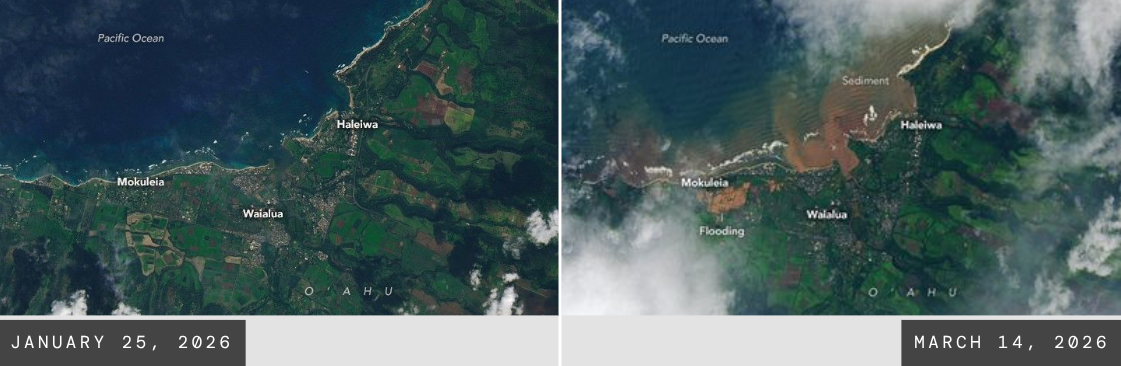
March 13-24, O’ahu, Hawaii, experienced the worst widespread flooding the island has seen in over 20 years.
“The flooding was the state’s most serious since 2004,” Josh Green, Gov. of Hawaii, said in a news conference.
The water covered roads and flooded neighborhoods – requiring emergency responses across the island.
“In response to a request for support from the Hawaii Emergency Management Agency (HIEMA), the NASA Disasters Program’s Disasters Response Coordination System (DRCS) activated March 20 to aid ongoing response efforts,” the National Aeronautics and Space Association (NASA) said.
The heavy rainfall also triggered landslides, blocking roads and increasing the overall damage. Communities experienced temporary isolation as flooded roads became impassable and emergency crews worked to respond to rapidly changing conditions.
“Honolulu Fire Department crews safely evacuated 72 campers and two dogs from Our Lady of Kea’au camp,” the department said in a statement on Facebook.
Roads were shut down, homes and businesses were damaged and cleanup efforts continued even after the storms passed.
“Communities such as Waialua and Haleiwa on Oʻahu’s north shore experienced devastating inundation,” the University of Hawaii said.
Events like these are gaining more attention as scientists continue to study how weather patterns are changing over time. The intensity and duration of storms like this suggest a growing trend toward more extreme weather events.
“The catastrophic flooding is not an isolated event, but one of many weather-related disasters that are becoming more frequent and intense as the climate crisis worsens,” Earth.org said.
The floods were caused by a variety of different weather systems. The most prominent of these systems was a Kona storm, which is unlike Hawaii’s usual trade wind weather.
“The two key elements [of flooding] are rainfall intensity and duration,” the National Weather Service (NWS) said.
Kona storms approach from the south and tend to move slowly or even stall over the islands. That slow movement allows rain to fall continuously over the same areas, increasing the likelihood of flooding.
“The slow-moving trough provided enough of a focus for low-level convergence to create nearly ideal conditions for flash flooding over the islands,” the NWS said.
Another major weather system is an atmospheric river, which is a long, narrow band of moisture systems that transport large amounts of water vapor across the ocean. These rivers can release intense rainfall when they reach land.
According to NASA, atmospheric rivers “are the largest transport mechanisms of freshwater on Earth.”
In Hawaii’s case, the added moisture intensified rainfall totals and prolonged the storm’s impact and the amount of floodwater.
“Over 400 homes destroyed with total damages exceeding $1 billion, thousands of people evacuated and hundreds rescued from rising floodwaters,” Earth.org said.
On top of the two systems, a large component was also El Niño. El Niño is the warming of ocean surface temperatures in the Pacific Ocean.
“In a warming world with warmer oceans, there is more evaporation and fuel for storms, leading to more powerful storms,” scientists at the National Oceanic and Atmospheric Administration (NOAA) said.
El Niño can shift weather patterns, sometimes bringing wetter conditions to regions like Hawaii.
“The warmer air can also hold more moisture, meaning heavier rainfall. Finally, rising sea levels mean higher storm surges and more flooding. Basic science points to bigger storms, changing weather patterns and more extremes” the NOAA said.
Hawaii’s unique geography made the probability of floods more likely to occur. The islands are formed by steep volcanic mountains and narrow valleys, which causes rainwater to move quickly downhill. Instead of slowly soaking into the ground, water rushes into streams and rivers, causing them to rise rapidly and overflow leading to flash flooding.
“More than 2 trillion gallons of water—enough to fill 3 million Olympic-sized swimming pools—inundated Hawaii in March,” the University of Hawaii said.
To help with the damages caused by the March 2026 floods you can do one of the following:
Donate money to the Hawaii Chamber of Commerce, Aloha United Way, Maui United Way, Hawaii Community Foundation or the Lahui Foundation.
You can also help by choosing to volunteer with the Hawaii Foodbank – Kauai Branch, to distribute necessities through the Community Distribution Hub (Oahu), or deliver aid through Maui Rapid Response.